The biggest lie in content marketing is that you need to post every day.
You don't. You need a system that lets one well-spent day produce what most people spend months trying to create. This is how executives, founders, and thought leaders stay consistently visible without treating content like a second job.
Why Most People Get Stuck in the Content Hamster Wheel
The typical approach to building a personal brand online looks like this: post something on Monday, run out of ideas by Wednesday, feel guilty about inconsistency by Friday, repeat.
It fails because it treats content creation as a continuous output problem when it's actually a batching and distribution problem.
The people who appear most consistently present online aren't posting in real time. They're operating from a content system — and that system almost always starts with a single concentrated production event.
The Core Concept: One Event, Many Assets
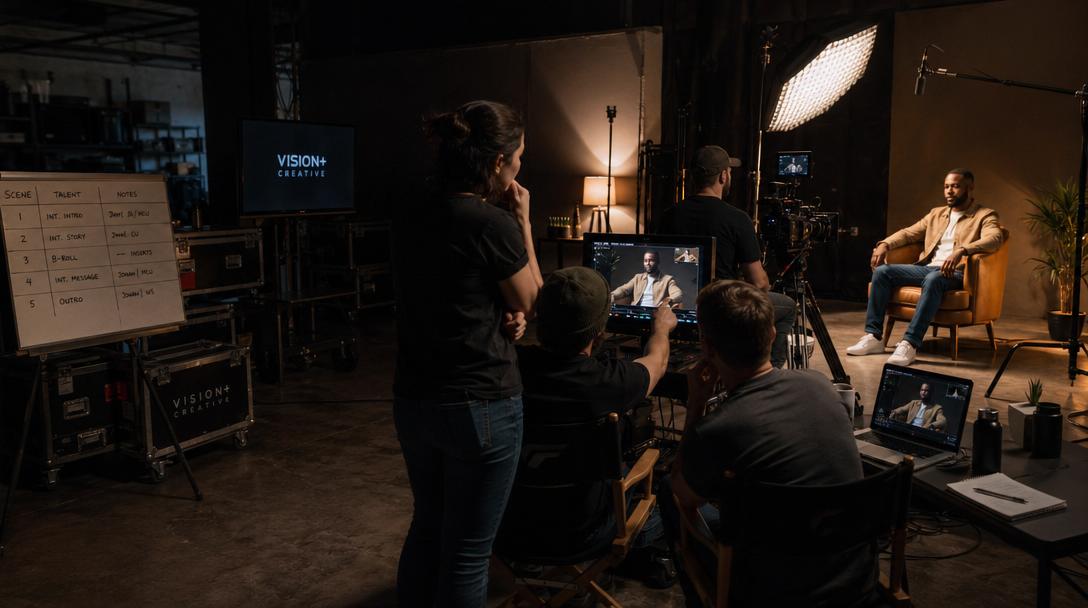
A production day is a focused block of time — typically 4 to 8 hours — during which you capture everything. Interviews, speaking segments, process walkthroughs, event footage, b-roll of your environment. All of it.
What you capture in one day becomes the raw material for weeks or months of content across every platform you care about. The key is knowing, before you start recording, exactly how that footage will be broken down and where each piece will live.
The hierarchy of assets
Every piece of long-form content contains multiple short-form assets. A 20-minute brand film contains:
- Hero film (2–3 minutes) — your anchor asset for your website and LinkedIn
- 60-second cuts (3–5) — primary social content for Instagram, LinkedIn, YouTube Shorts
- 30-second cuts (5–8) — Reels, TikToks, story ads
- 15-second cuts (8–12) — platform-native short content and paid ad creatives
- Audio pulls — podcast clips, quote cards, newsletter excerpts
- Still frames — thumbnail-quality photography pulled from video frames
- Written content — transcripts turned into blog posts, LinkedIn articles, email newsletters
One camera roll. Thirty-plus publishable assets. Same message, formatted for each surface.
What to Capture in a Production Day
1. Your core message on camera
Sit down and talk, at length, about what you believe, how you work, and who you serve. This isn't a polished speech — it's a structured conversation. Cover your origin, your philosophy, your process, and your client outcomes. A skilled production team will ask the right questions to draw this out of you. The goal is 45 to 90 minutes of raw conversation from which the best 2 to 3 minutes can be extracted.
2. Environment and b-roll
Your physical environment — your studio, office, workspace — communicates credibility before you open your mouth. Capture it. B-roll of you working, reviewing materials, walking through a space, or using your tools is the visual texture that makes finished content feel real rather than staged.
3. Testimonials or social proof moments
If you have clients, colleagues, or collaborators who can speak to working with you — capture them on the same day. Even a two-minute testimonial on camera becomes multiple quote cards, a short social proof clip, and supporting material for longer content.
4. Process documentation
Walk through how you do what you do. For a consultant, this might be a whiteboard breakdown. For a coach, a session walkthrough. For a speaker, the behind-the-scenes of preparation. This type of content performs consistently well because it delivers genuine value — people learn something.
The Distribution Map
Capturing content is only half the system. The other half is knowing exactly where each asset goes.
| Asset | Platform | Purpose |
|---|---|---|
| Hero brand film (2–3 min) | Website, LinkedIn Featured | Anchor / first impression |
| 60-second cut | LinkedIn, YouTube Shorts | Reach + authority |
| 30-second cut | Instagram Reels, TikTok | Discovery |
| 15-second cut | Stories, Paid ads | Retargeting |
| Audio pull | Podcast, Spotify | Long-form audience |
| Transcript → article | Blog, LinkedIn Articles | SEO |
| Pull quote + still | Twitter/X, Instagram static | Engagement |
| Newsletter excerpt | Email list | Nurture |
Map this before production day, not after. It ensures you're capturing the right shots for each surface.
The Compounding Effect
Here's what most people miss about this model: it's not just efficient. It's compounding.
Content produced in January still gets discovered in October. A blog post optimized for search keeps bringing in readers for years. A short clip that performs well gets redistributed by the algorithm months after you posted it.
When you build a content system this way, every production day adds to an existing library rather than replacing it. Your visibility grows cumulatively, not episodically. The work you put in today is still working for you next year.
The Practical Starting Point
If you've never done a production day before, start here:
- Define your platforms — where do you actually want to be visible? Pick two or three. Know what performs on each.
- Plan your talking points — not a script, but a list of five to seven ideas or beliefs you want to communicate on camera.
- Block a full day — not two hours. A real production day needs time for setup, warmup, multiple takes, and b-roll.
- Think in assets — before you shoot anything, ask "what will this become, and where will it live?"
One production day, done well, buys you the kind of consistent visibility that most people try to sustain by posting every single day and still falling behind. The output is the same. The effort is not.
Live Digital Box is built around this exact model — one focused session that produces months of content for founders, executives, and thought leaders. Talk to us about what that could look like for you.