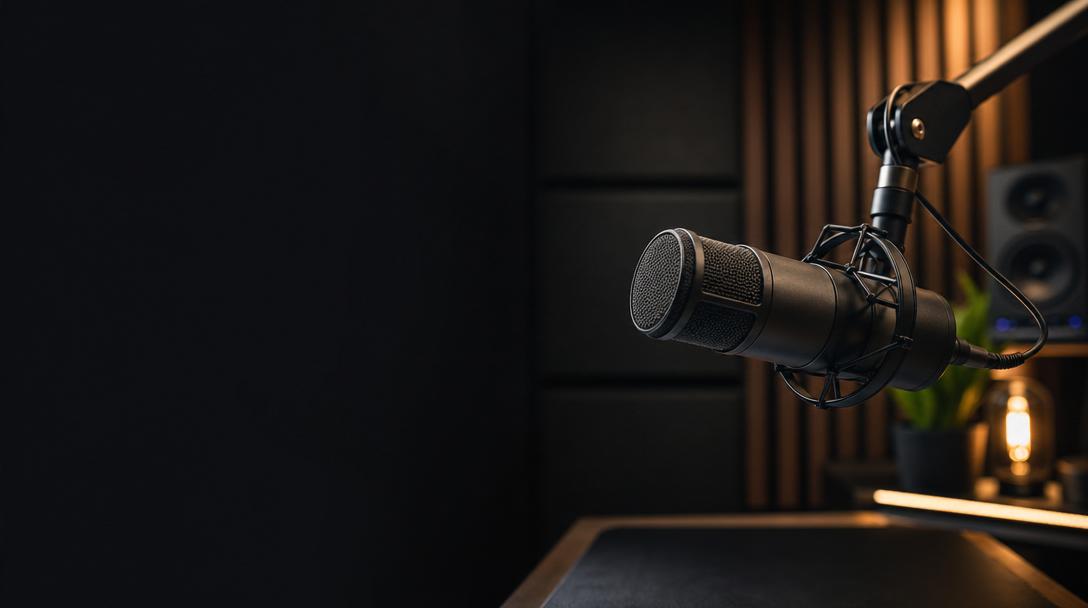
Most new podcasters make the same mistake: they focus on what to say before they've solved how it'll sound.
The content problem is actually the easier one. The setup problem — audio, visual, environment, production workflow — is what determines whether anyone stays past the first minute.
Why This Matters More Than You Think
Podcasting is a long-form trust medium. People listen while commuting, exercising, cooking — they're giving you 30 to 60 minutes of focused attention in exchange for genuine value. Before they commit to that exchange, they make a snap judgment in the first 15 to 30 seconds.
That judgment is almost entirely based on audio quality.
Poor audio doesn't just sound bad — it signals effort, or the lack of it. If someone's voice sounds muddy, echo-laden, or buried under background noise, the unconscious conclusion is: this person didn't care enough to fix that. It's not a fair judgment, but it's a near-universal one.
The Audio Gap
This is where most amateur setups fail immediately.
What amateur audio sounds like
- Room reverb / echo — sound bouncing off walls, giving a hollow, tunnel-like quality
- Background noise — HVAC hum, street noise, keyboard clicks, refrigerator buzz
- Proximity issues — either too far from the mic (thin, distant sound) or too close (harsh plosives on p and b sounds)
- Inconsistent levels — volume that jumps around between speakers or between episodes
Any one of these is enough for a listener to decide the podcast isn't worth their time.
The microphone
A professional podcast setup doesn't require the most expensive microphone on the market. It requires the right microphone used correctly.
Dynamic microphones (like the Shure SM7B or Electro-Voice RE20) are workhorses for spoken word content because they reject background noise and room reflections more aggressively than condenser microphones. Condenser microphones pick up more detail and air, but they also pick up everything else in the room.
The room
A microphone upgrade is wasted in a bad room. Acoustic treatment — absorbing the reflections that bounce off hard surfaces — is as important as the microphone itself. Professional setups use acoustic panels at first-reflection points, heavy furnishings that absorb sound naturally, and dedicated spaces designed for clean recording.
Recording in a large, bare room with hard floors and white walls will sound like a large, bare room regardless of what microphone is in front of you.
The Visual Dimension
Podcasting started as audio-only, but in 2024 and beyond, video is non-negotiable for growth and authority. Spotify, YouTube, and LinkedIn all surface video podcast content with significantly more reach than audio-only.
What professional video looks like
A professional video podcast setup communicates three things before anyone speaks: this is intentional, this person invests in their brand, and this is worth watching. The key elements:
- Camera: A dedicated mirrorless or cinema-quality camera with a lens that creates background separation (shallow depth of field).
- Lighting: A key light at roughly 45 degrees to your face eliminates the flat, washed-out look of overhead room lighting.
- Background: A deliberately styled bookshelf, branded backdrop, or well-lit studio environment signals professionalism. A blank white wall signals that no thought was put into the visual.
- Framing: Eye-level camera placement, proper headroom, and a consistent frame across all episodes creates a cohesive look that builds recognition over time.
The Production Workflow
Even with great hardware, an inconsistent production workflow creates inconsistent output. Professional podcast production includes:
Pre-production
Guest briefing documents so guests arrive prepared. Technical checks before recording starts. A consistent intro/outro structure that doesn't change episode to episode.
Recording
Separate audio tracks for each speaker — critical for clean editing. A backup recording in case of technical failures. A clear in-ear monitoring setup so hosts can hear themselves and guests clearly.
Post-production
Noise reduction and dynamic range compression. Removal of filler words, false starts, and dead air. Music, transitions, and sound design that makes the finished product feel cohesive. Show notes, transcripts, and chapter markers for discoverability.
Distribution
Upload to a host that distributes to all major platforms simultaneously. SEO-optimized episode titles and descriptions. Audiograms and short clips pulled for social promotion.
This is the operational difference between a podcast that grows and one that stagnates: the ones that grow treat distribution as part of the production process, not an afterthought.
Where to Start
If you're building a podcast from scratch, the minimum viable professional setup looks like:
- Dynamic microphone (SM7B or equivalent) + interface or preamp with enough gain
- Treated recording space — even a walk-in closet with clothes on the racks records better than most home offices
- A camera with manual controls and a lens that creates background separation
- One key light — even a single good light eliminates the biggest visual problems immediately
If you're upgrading an existing setup, start with the room before you start with the gear. Most audio problems are room problems, not microphone problems.
Podcast Space Plus is Live Digital Box's full-service podcast production system — studio access, professional recording and post-production, distribution, and the infrastructure to turn your podcast into a long-form authority asset. Learn more about what's included.